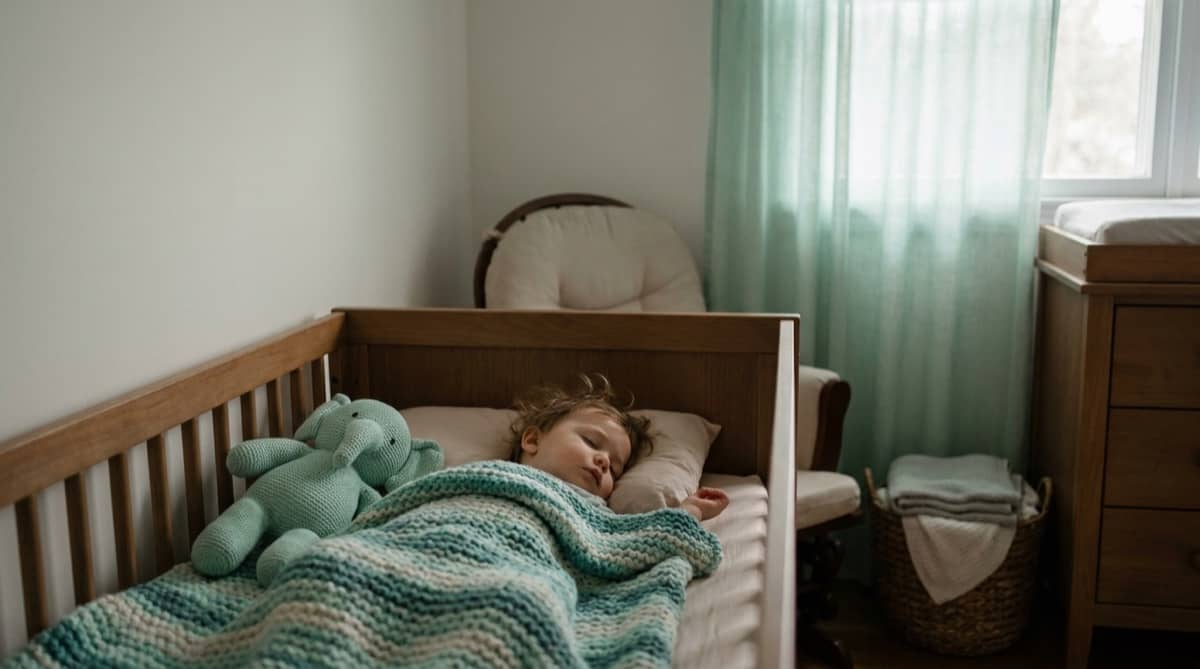
The 8–10 Month Sleep Regression, Explained
Crawling, separation anxiety, and nap changes collide. What helps and what to ride out.
By Jordan Brooks · Certified pediatric sleep consultant
Updated June 11, 2026

What the 8-10 Month Sleep Regression Actually Is
The 8-10 month sleep regression is a temporary period - usually two to six weeks - when a previously decent sleeper suddenly fights bedtime, wakes repeatedly overnight, takes short or skipped naps, and seems harder to settle. The word "regression" is misleading. Your baby's sleep architecture is not breaking down; it is being renovated. Underneath the rough nights, your baby is acquiring a remarkable cluster of new abilities all at once: crawling, pulling to stand, cruising along furniture, pointing, babbling with real consonants, understanding that you continue to exist when you leave the room, and beginning to consolidate daytime naps. Each of these milestones competes for the same brain bandwidth that quiet, consolidated sleep requires.
It helps to reframe what "good sleep" means at this age. The American Academy of Pediatrics is explicit that a good sleeper is not a baby who lies unconscious for ten or twelve unbroken hours. A good sleeper is a baby who wakes briefly between sleep cycles - which every human does, several times a night - and can get back to sleep without much help. All babies surface from light sleep roughly every 50 to 60 minutes. The ones who "sleep through" have simply learned to roll over, resettle, and drift off again on their own. During a regression, that resettling skill temporarily gets overwhelmed by everything new the brain is processing, so the brief wakings turn into full wake-ups that need you.
Crucially, this is not a sign that anything is wrong with your baby, your parenting, or the sleep habits you built earlier. It is a developmental signature - so predictable that pediatric sleep researchers note these disruptions tend to cluster around the 8-to-10-month window precisely because so many milestones land there. Knowing it is finite and normal is half the battle, because the most common way parents accidentally extend a regression is by panicking and changing everything at once.
Why It Happens: The Developmental Drivers
Separation anxiety is the emotional engine of this regression. Somewhere around 8 to 9 months, babies develop "object permanence" - the understanding that you exist even when they cannot see you. That is a cognitive leap to celebrate, but it has a nighttime cost: when you leave the room at bedtime, your baby now grasps that you went somewhere, and wants you back. Wakings that used to end with a quick resettle now end with a cry of protest because being alone suddenly feels like a problem to solve. This peaks for many babies between 9 and 18 months and is a normal, healthy sign of attachment, not insecurity.
Gross-motor development is the physical engine. Between 8 and 10 months most babies are crawling, pulling to stand, and starting to cruise. A brain busy wiring a brand-new motor skill will literally rehearse it during light sleep - which is why parents so often find their baby standing in the crib at 2 a.m., gripping the rail, having woken themselves up mid-practice and not yet knowing how to get back down. Sitting and lying back down is a separate skill that lags behind standing up by days or weeks, so the baby gets "stuck" and calls for help.
Two more drivers round out the picture. First, language: receptive understanding and babbling surge now, and a mind flooded with new sounds and meanings is a more easily aroused mind. Second, the nap transition: many babies are dropping from three naps to two right around this age, and a mistimed schedule creates either an overtired baby (too much awake time, leading to a flood of stress hormones that fragment night sleep) or an undertired one (too much day sleep, leaving not enough "sleep pressure" for night). Teething can layer discomfort on top, though it is frequently over-blamed; true teething pain is usually a day-or-two event, not a multi-week pattern.
How Sleep Normally Looks at 8, 9, and 10 Months
Having a realistic baseline keeps you from chasing an impossible standard. Per AAP and American Academy of Sleep Medicine guidance, infants 4 to 12 months should get 12 to 16 hours of total sleep per 24 hours, naps included. As babies cross their first birthday, that need eases to 11 to 14 hours for ages 1 to 2 years. Most of that total at 8-10 months is consolidated at night - roughly 10 to 12 hours in the crib (with normal brief wakings) - plus daytime naps making up the rest.
At 8 months, a baby is often still on three naps but wobbling, with the late-afternoon catnap becoming hard to fit in. By 9 months, the majority have settled into a two-nap rhythm: a mid-morning nap and an early-afternoon nap, each roughly 60 to 120 minutes, with about 2.5 to 3.5 hours of awake time between sleeps. By 10 months, two naps is the firm norm, total day sleep is commonly in the 2-to-3.5-hour range, and the bedtime that works for most families falls somewhere between 6:30 and 8:00 p.m., timed so the baby is drowsy-but-awake rather than overtired.
Think of it as a daily sleep budget. If your 9-month-old needs around 13.5 hours total and naps for 3 of them, that leaves about 10.5 hours of night sleep - which, spread across a 7:00 p.m. bedtime and a 6:30 a.m. wake-up, is exactly right with a couple of brief resettles in between. When the night falls apart, the most useful first question is rarely "what bad habit formed?" and far more often "is the daytime sleep and timing slightly off?" Overtiredness and too-late bedtimes cause more 8-10 month night wakings than almost anything else.
A Step-by-Step Plan to Get Through It
Step one: hold safe sleep absolutely steady. Every nap and every night, place your baby on their back, alone, in a crib or bassinet with a firm, flat surface and nothing but a fitted sheet - no pillows, bumpers, blankets, or stuffed animals. If your baby now rolls or stands, you still always put them down on the back, but you do not have to flip them back over if they move themselves once they can roll both ways. A wearable sleep sack replaces blankets safely and adds a comforting routine cue.
Step two: audit and fix the schedule before you change anything else. Confirm your baby is on age-appropriate wake windows (roughly 2.5 to 3.5 hours at this age) and getting enough - but not too much - day sleep. If bedtime has crept late, move it earlier by 15 to 30 minutes; an earlier bedtime is the single most common fix for early-morning wakings and bedtime battles, because an overtired baby sleeps worse, not better. If the third nap is collapsing, begin a gentle transition to two naps rather than forcing a nap that no longer fits.
Step three: protect a short, predictable, calming bedtime routine - the same four or five steps in the same order every night (for example: bath, pajamas and sleep sack, a book or two, a song, into the crib). Routine is how a baby's nervous system reads the runway to sleep. Step four: practice independent settling. Put your baby down drowsy but awake so they fall asleep where they will wake - in the crib, not in your arms - which lets them rebuild the resettle skill the regression knocked loose. Step five: respond to wakings consistently with your chosen approach. Whether you do brief check-ins, graduated waiting, or staying in the room, pick one method and apply it the same way for at least a week before judging it; flip-flopping nightly teaches the baby that enough protest eventually changes the rules.
Step six: attack the milestone in daylight, not darkness. If your baby is pulling to stand and getting stuck in the crib, spend ten minutes several times a day practicing getting from standing back down to sitting, and crawling on the floor. The brain rehearses what it has not yet mastered; the more the skill is consolidated awake, the less it intrudes at night. Step seven: feed the day, not the night. By 8-10 months a healthy, growing baby getting solids plus breast milk or formula generally does not need overnight calories to thrive, so if night feeds have multiplied, talk with your pediatrician about gently shifting calories into daytime. Step eight: front-load daytime connection. Extra one-on-one floor play, peekaboo, and narrating where you go ("I'm going to the kitchen, I'll be right back") feed the separation-anxiety need during the day so the bedtime tank is fuller.
The Three-to-Two Nap Transition, Demystified
The nap transition is the part of this regression most parents misread, because dropping a nap temporarily makes things worse before it makes them better. The signs your baby is ready to move from three naps to two are concrete: the third (late-afternoon) nap becomes a battle or gets refused, naps start eating into a previously solid bedtime, or your baby is suddenly waking happy and ready to play at 5 a.m. because total daytime sleep is now too much for their night to absorb.
To make the switch, gradually stretch the morning wake window so the first nap lands a little later (around 9:00 to 9:30 a.m. for many babies), put the second nap in the early afternoon (around 1:00 to 2:00 p.m.), and let the old third nap fall away. On two naps, an earlier bedtime is your safety net for the first couple of weeks: because the awake stretch from the afternoon nap to bedtime is now longer, a baby can tip into overtiredness, so a 6:30 p.m. bedtime on hard days prevents the overtired-equals-worse-night spiral. Expect a bumpy ten to fourteen days as the new rhythm settles.
A common trap is dropping the nap cold or too early. If skipping the third nap leaves your baby falling apart by late afternoon for more than two weeks, they may not be fully ready - in which case you can offer a brief "bridging" catnap or a slightly earlier bedtime while you keep gently nudging wake windows longer. The goal is two restorative naps and a night that holds, not rigid adherence to a clock. Let your baby's mood, the ease of falling asleep, and night quality tell you whether the schedule is working.
Common Mistakes and What Trips Parents Up
The biggest mistake is introducing brand-new sleep crutches in a panic. After a few brutal nights it is tempting to start rocking fully to sleep, bringing the baby into your bed, or feeding back to sleep every waking - habits that may not have existed before. The regression ends in a few weeks; a new sleep association you created to survive it can outlast it by months. You can absolutely offer extra comfort - the issue is creating a new requirement, like "only falls asleep being bounced," that your baby then needs reproduced at every 2 a.m. waking.
The second trap is bed-sharing as a quick fix. It is completely understandable at 3 a.m., but the AAP advises against bed-sharing because of the elevated risk of sleep-related infant death; the safe alternative is room-sharing, with the baby on a separate firm sleep surface (crib, bassinet, or play yard) in your room. The AAP recommends room-sharing for at least the first six months. If you ever feed in bed, the safest practice is to feed and then return the baby to their own sleep space, and to make sure there is no soft bedding, pillow, or gap they could become wedged in.
Other frequent missteps: keeping bedtime too late because a tired baby seems "not ready" (overtiredness mimics a second wind and worsens wakings); changing your nighttime response every single night so the baby never learns what to expect; assuming every waking is hunger and feeding reflexively, which can create a true night-feeding habit and disrupt daytime appetite; over-attributing weeks of bad sleep to teething; and abandoning a reasonable approach after only two or three nights. Most evidence-based settling strategies need five to seven consistent nights before you can judge them. Consistency, not intensity, is what resolves a regression.
Safe Sleep Is Non-Negotiable - Even When You Are Exhausted
Sleep deprivation is exactly when safe-sleep shortcuts feel most reasonable and are most dangerous, so it is worth restating the rules in full. For every sleep, the AAP and NICHD Safe to Sleep guidance is: place your baby on their back; use a firm, flat, level sleep surface (a crib, bassinet, or play yard that meets current safety standards) covered only by a fitted sheet; keep the space completely bare of soft bedding, bumpers, pillows, blankets, and toys; do not let the baby get too warm; offer a pacifier for naps and night; and room-share without bed-sharing. Inclined sleepers and any product that props or angles a baby are not safe sleep surfaces.
Two points matter specifically at 8-10 months. First, swaddling: if you were still swaddling, stop completely once your baby shows any sign of rolling, which for most babies is well before this age - a swaddled baby who rolls to their stomach cannot free their arms to push up, raising the suffocation risk. Use a sleeveless sleep sack instead. Second, rolling and standing in the crib: this is normal and safe within a bare crib. You always place the baby down on the back, but once they can roll both directions on their own you do not need to keep flipping them; just make sure the crib is empty, the mattress is on its lowest setting, and there is nothing they can use to climb or get tangled in.
If exhaustion is pushing you toward unsafe choices - dozing off with the baby on a couch or armchair, which is more dangerous than a planned bed setup - the safer move is to feed the baby somewhere you will not fall asleep, or to hand off to a partner so you can rest. The Safe to Sleep campaign exists because these decisions, made while depleted, carry real risk. No sleep strategy is worth compromising the sleep-environment basics.
What the Evidence Says
On how much sleep babies need, the figures here come from the American Academy of Sleep Medicine consensus that the AAP endorses: 12 to 16 hours per 24 hours for infants 4 to 12 months and 11 to 14 hours for children 1 to 2 years, naps included. On what normal night waking looks like, HealthyChildren.org (the AAP's parent-facing site) states plainly that frequent brief waking is normal and even protective, and that the developmentally healthy goal is a baby who can resettle - not one who never stirs. This is the single most reassuring evidence-based fact for a parent in the thick of a regression.
On safety, the recommendations are not soft suggestions - they reflect AAP policy and the NICHD Safe to Sleep campaign built on decades of research linking back-sleeping, firm bare surfaces, and room-sharing to dramatically lower rates of SIDS and sleep-related death. The guidance to stop swaddling at the first sign of rolling, to keep the sleep space bare, and to avoid bed-sharing all trace to this evidence base. On feeding, CDC infant and toddler nutrition guidance and the AAP agree that solids start around 6 months alongside continued breast milk or formula, and that by the second half of the first year a healthy, growing baby generally does not require overnight feeds to meet nutritional needs - useful context when night wakings have turned into reflexive feeding.
One honest caveat the evidence supports: the term "sleep regression" itself is a popular label rather than a formal medical diagnosis, and the exact timing varies from baby to baby. What is well established is that the underlying milestones - separation anxiety with object permanence, the surge in gross-motor skills, language gains, and the nap transition - genuinely cluster in late infancy and genuinely disrupt sleep. So while the catchy name is informal, the developmental reality behind it is real, predictable, and temporary.
When to Call Your Pediatrician: Red Flags
A true developmental sleep regression should not make your baby seem sick. It disrupts sleep but leaves daytime feeding, energy, and overall well-being intact. That distinction is your red-flag filter. Call your pediatrician promptly if night waking arrives alongside any of these: a fever (especially 100.4 F / 38 C or higher in a young infant, or any persistent or high fever); signs of pain such as ear-tugging with crying, inconsolable screaming, or pulling up the legs; vomiting or diarrhea; poor feeding, fewer wet diapers, or signs of dehydration; or any breathing difficulty, noisy or labored breathing, pauses in breathing, or worrisome snoring. Breathing concerns warrant urgent evaluation.
Also reach out if the sleep disruption does not fit the expected pattern. Get your pediatrician's input if the "regression" drags on well past six weeks with no improvement despite consistent routines; if your baby seems to be losing previously gained skills or is not meeting milestones; if there is poor weight gain or growth faltering; if your baby is excessively sleepy and hard to wake rather than simply waking too often; or if you notice loud, persistent snoring or gasping, which can signal sleep-disordered breathing worth assessing. Trust your instincts - you know your baby's baseline better than anyone, and "this feels different from a phase" is a legitimate reason to call.
Finally, take your own well-being seriously. Chronic sleep deprivation is hard, and if you are feeling persistently depressed, anxious, hopeless, unable to sleep even when the baby sleeps, or having frightening thoughts, that is a medical issue deserving care - talk to your own clinician or your baby's pediatrician, who can connect you with support. Parental mental health is part of infant sleep health, not separate from it. Asking for help, sharing nights with a partner, or leaning on family during a rough stretch is good parenting, not failure.
Bottom Line and How to Keep Your Footing
The 8-10 month sleep regression is your baby's developing brain doing exactly what it should - learning to crawl, stand, communicate, and understand that you are a separate person worth missing - at the temporary expense of smooth nights. It typically lasts two to six weeks, and it ends. The strategy that gets you through is unglamorous and durable: keep safe sleep ironclad, keep the schedule and wake windows age-appropriate, keep bedtime early enough to avoid overtiredness, keep the bedtime routine short and identical every night, give the new motor skills lots of daytime practice, and respond to wakings with one consistent approach long enough to let it work.
Resist the two reflexes that turn a phase into a habit: inventing new sleep crutches you will have to dismantle later, and changing your plan every night out of exhaustion. Lean instead on consistency, because predictability is what a flooded little nervous system craves most. Pour extra connection and reassurance into the daylight hours - that is how you honor the separation anxiety driving the wakings without rewiring your nights. And remember the AAP's reframe: the target is a baby who can resettle, not a baby who never wakes.
Keep your red-flag list close, so you can tell a normal developmental phase from genuine illness and act fast when it matters - fever, pain, poor feeding, dehydration, or any breathing concern means call your pediatrician. Everything short of that is usually weatherable with patience, a calm routine, and the knowledge that this storm is finite. In a few weeks your newly mobile, more communicative, more attached baby will settle into a two-nap rhythm and sleep will knit back together. You are not undoing your progress; you are riding out a growth spurt of the mind. Hold the line, stay safe, and it passes.
Was this article helpful?
Frequently asked questions
How long does the 8 month sleep regression last?
For most babies it lasts about two to six weeks. The length depends largely on consistency: when parents hold safe-sleep rules, an age-appropriate schedule, and a steady bedtime routine, it tends to resolve faster. If disruption persists well past six weeks despite consistent routines, or your baby seems unwell, check in with your pediatrician.
Is the 8-10 month sleep regression real or just a myth?
The catchy term is an informal label, not a formal medical diagnosis, but the developmental reality behind it is well documented. Separation anxiety, crawling and pulling to stand, language gains, and the three-to-two nap transition genuinely cluster around 8-10 months and genuinely disrupt sleep. So the name is casual, but the sleep disruption and its causes are real and predictable.
Should I let my baby cry it out during the regression?
That is a personal decision, and several evidence-based approaches exist along a spectrum from brief timed check-ins to staying in the room. The key is not which method you pick but applying one method consistently for at least five to seven nights so your baby learns what to expect. Always combine any approach with strict safe sleep, an age-appropriate schedule, and an early enough bedtime, and talk with your pediatrician if you are unsure.
Does the 8 month regression mean I should drop a nap?
Sometimes. Many babies move from three naps to two right around 8-10 months, and a collapsing late-afternoon nap, naps eating into bedtime, or early-morning wakings can signal readiness. Transition gradually by stretching wake windows, and use an earlier bedtime as a safety net for the first couple of weeks so your baby does not become overtired during the longer afternoon awake stretch.
Why does my baby keep standing up in the crib at night?
Pulling to stand is a brand-new skill at this age, and the brain rehearses it during light sleep, so babies wake themselves mid-practice and then get stuck because sitting back down lags behind standing up. The fix is daytime practice: several times a day, help your baby learn to lower from standing to sitting and to crawl, which consolidates the skill so it intrudes less at night. Keep the crib bare and the mattress on its lowest setting.
Does my 8-10 month old still need to eat at night?
By the second half of the first year, a healthy, growing baby who is eating solids plus breast milk or formula generally does not need overnight calories to thrive, according to AAP and CDC guidance. If night feedings have multiplied during the regression, it is often comfort rather than hunger. Talk with your pediatrician before night-weaning to confirm your baby is growing well and to plan a gentle approach.
Can teething cause the 8 month sleep regression?
Teething can add discomfort, but it is frequently over-blamed for weeks of bad sleep. True teething pain is usually a one-to-two-day event tied to a tooth breaking through, not a multi-week pattern. If your baby has weeks of disrupted sleep, the developmental drivers - separation anxiety, new motor skills, and the nap transition - are far more likely the main cause. Persistent fever or inconsolable pain is not normal teething and warrants a pediatrician call.
Is it safe for my baby to sleep on their stomach now that they roll?
You should always place your baby down on their back for every sleep. However, once your baby can roll both directions independently, you do not need to keep flipping them back if they move themselves during sleep. The essential safeguards are a firm, flat, completely bare crib - only a fitted sheet, no blankets, pillows, bumpers, or toys - and stopping swaddling at the first sign of rolling so the arms are free.
References
- 1.Healthy Sleep Habits: How Many Hours Does Your Child Need? — American Academy of Pediatrics (HealthyChildren.org)
- 2.Sleeping Through the Night — American Academy of Pediatrics (HealthyChildren.org)
- 3.Ways to Reduce Baby's Risk of SIDS and Other Sleep-Related Causes of Infant Death — NICHD Safe to Sleep (National Institutes of Health)
- 4.Safe Sleep: Back is Best, Avoid Soft Bedding, Inclined Surfaces & Bed-Sharing — American Academy of Pediatrics (HealthyChildren.org)
- 5.When, What, and How to Introduce Solid Foods — Centers for Disease Control and Prevention
- 6.FAQs - Safe to Sleep — NICHD Safe to Sleep (National Institutes of Health)
- 7.Getting Your Baby to Sleep — American Academy of Pediatrics (HealthyChildren.org)